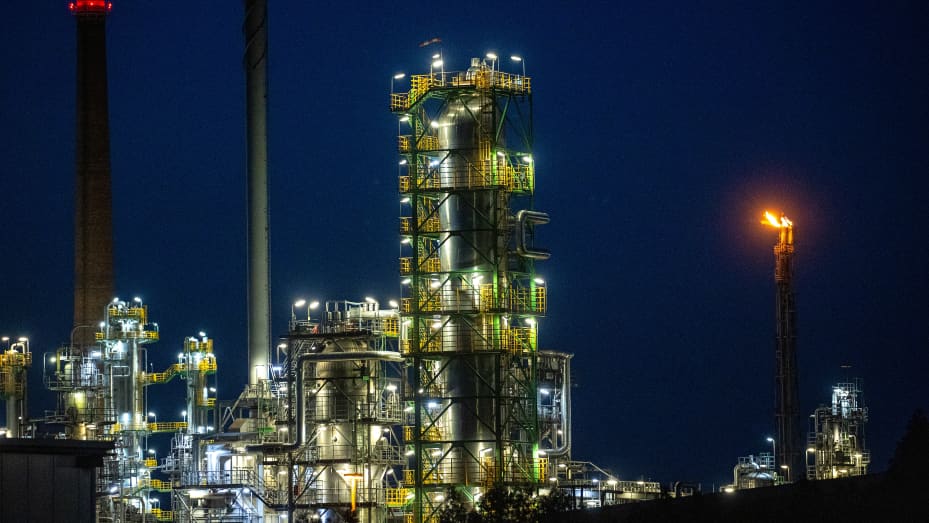
The front-page headline of Saturday’s Weekend FT reads “Germany seizes Rosneft oil refineries”, which in normal circumstances would certainly also seize people’s attention. These are not normal times of course and German Chancellor Olaf Scholz called it “an unavoidable step”. Rosneft’s main PCK refinery is located on the Druzhba pipeline from Russia, is 54% owned by Rosneft and is vital to energy supplies in the Brandenburg region while two other refineries are located in Karlsruhe and Bavaria. With an EU embargo on Russian crude deliveries coming into force on January 1, the Rosneft refineries’ future was in doubt if crude oil supplies for them could not be secured because of the sanctions imposed on Russia after its invasion of Ukraine.
Chancellor Scholz highlighted that this was a major decision but one that was needed to ensure that Germany was less dependent on Russia, which Scholz noted was no longer a reliable energy provider – this after his predecessor Angela Merkel spent years increasing the country’s dependence on Russian energy through backing the construction of the Nord Stream 2 gas pipeline, enabling Russia to both double gas exports to Europe while also bypassing Ukraine as a transit country. The existing Nord Stream 1 pipeline has now been closed by Russia (along with Nord Stream 2’s completion being abandoned) – something that never happened to any of the other oil or gas pipelines even during the darkest days of the Cold War. It is hard to believe that relations between Russia and Germany have fallen below the low point of the Cold War, but that is exactly what has happened.
The closure of the Nord Stream pipeline and the takeover of Rosneft’s refining assets in Germany are just the latest manifestations of the struggle between Russia and the western allies over the fate of Ukraine, which Russia invaded on February 24th. After initial successes, Russian forces in eastern Ukraine have been forced back by Ukrainian armed forces supplied with western arms and technology. The swift victory sought by President Vladmir Putin in Ukraine’s Donbas region appears at present to be out of reach with Ukraine forcing Russia onto the defensive and gaining ground in the Donbas.
The geopolitical winds may also be shifting slightly. With Russia isolated from the western world, Moscow’s most important global relationship is with China. This was once described as a partnership with “no limits”. Even leaving aside the political hyperbole associated with the relationship, it is clear that there are limits to it, even if these have not been explicitly stated. Putin acknowledged this in his statement at the recent Shanghai Co-operation Organisation meeting when he talked about understanding China’s expressed concerns. Both sides have different public interpretations as evidenced by the messages they each send their populations to justify supporting the other’s positions on various issues – not least of which is the war in Ukraine where China, echoing Russia’s claims, has blamed the west’s expansionism for causing it. In return, Putin has blamed the US and its allies for the crisis over Taiwan.
Whether China was informed of the Russian invasion of Ukraine in advance of it happening last February is a moot point in my view. The invasion did happen and now both parties must deal with the consequences. Xi Jinping would almost certainly have preferred a more ordered world since China’s share of global trade is much greater than Russia’s while Beijing’s desire for political stability seems, on the face of it, to be stronger than Moscow’s. The Soviet Union once led China in economic heft, technological ability and global influence. That, however, was a long time ago and since China’s opening from the 1980s onwards and the collapse of the Soviet Union after 1989, the roles have undoubtedly been reversed and that reversal looks to be both permanent and growing.
Russia has much of what China wants – energy that can be redirected – over time – away from Europe and towards China, particularly as Europe is now taking its own steps to reduce its dependence on Russian oil and gas supplies as well as more advanced weapons than China currently possesses. It is also impossible to ignore the strategic benefit to China of a Russia opposed to the US, their common strategic foe. Why upset the apple cart by criticising Russia when things are going rather well for China in the relationship.
There are clearly constraints on China’s actions. It will not explicitly breach the sanctions imposed by the US and others, for fear of secondary sanctions against Beijing which would hamper its growth – already under pressure because of the country’s uncompromising approach to dealing with Covid-19. For this reason, it seems unlikely that Chinese companies will acquire the western stakes in Russian assets – even valuable energy assets – being sold by their current owners in response to the sanctions regime.
China is buying more Russian energy though, a logical trade for both sides with the infrastructure to deliver energy in place on both sides of the Sino-Russian border. Reports suggest that Russian exports to China have risen by almost 50% in the past seven months (imports the other way by much less), reflecting Moscow’s increasing dependency on Beijing’s willingness to step into the breach. I cannot imagine that this comes at no cost – now or in the future – to Russia. Moscow will be beholden to Beijing in a whole range of areas – commercial interactions, global diplomacy, international bodies etc.
Geopolitically there are also growing challenges for Russia in Central Asia. In Soviet times the Central Asian republics were closely tied economically to Russia. Over the past thirty years, with many of the same autocrats in power, those economic ties and dependencies have changed as the region’s focus turned to China as a vast market for energy and raw materials from Central Asia while commercial ties with Russia diminished. For them, China is the future while Russia is now a proven potentially expansionist neighbour to their north – it is perhaps no surprise that Xi Jinping promised support for Central Asia’s continued independence before he met Putin in Uzbekistan. Resources are vital for China and competition between suppliers is beneficial. Despite China’s desire for these strategically-located energy imports, President Xi will not want to find Russia controlling too much of China’s raw material imports from Central Asia.
India is also seen by many as a beneficiary of Russia’s isolation – with the latter economically more dependent on energy supplies to India as well as to China. That has not stopped Indian prime minister Narendra Modi from publicly criticising Putin’s Ukraine adventurism to his face. It may be a simple statement of opposition to the war but the mood music does seem to be changing somewhat as the war continues to disrupt energy and grain supplies as well as retain the potential to escalate further – all this despite the fact that Russia is being pushed back by the Ukrainians and the quick war and victory that Putin might have been led to believe was possible looks set to continue indefinitely.
Domestically Putin is under pressure – but not from any liberal anti-war faction. Instead, the pressure comes from an overtly pro-war faction of ex-military servicemen and bloggers who believe that the president is not doing enough to bring the war to a successful conclusion. However, at the same time, avoiding the mass mobilisation of Russians into the army maintains the fiction that the “special military operation” is a cost-free, fairly limited campaign which should leave daily life in Russia broadly unaffected – which it clearly no longer is, if it ever was limited and cost-free.
What does this all mean for Russia and China
The overriding geopolitical conclusion we must surely reach is that Russia is now the junior partner in the relationship with China, whether Moscow understands (which it surely must) or accepts this state of affairs or not. The Ukraine war has isolated Russia, perhaps more than it had anticipated and badly affected its finances – which continue to deteriorate – certainly more than it had anticipated I suspect. China has therefore become an even more important ally than it has been hitherto. Putin himself noted that the Chinese are tough negotiators, something with which he will be familiar after the Power of Siberia gas deal negotiations. Given Russia and China’s relative positioning in the world, new negotiations for future long-term energy supplies from Russia – and indeed activities in many other spheres of Russian life – will not get any easier over the next few years (at least not for Russia).
 Global Energy Comment